Experience biotechnology research and explore its impact in research and industry.
Students will gain hands-on experience with modern biotechnolgy techniques and develop technical skills for future laboratory research and industry postions.
Course Objectives:
CO 1. Design strategies to manipulate DNA to create new proteins with applications in bioremediation, drug discovery, pharmaceuticals, biomedicine, food science, and many other disciplines.
CO 2. Explain a variety of techniques in the manipulation of recombinant DNA and protein expression.
CO 3. Create a detailed written record of experimental procedures, results, and conclusions that is reliable and replicable.
CO 4. Interpret data and controls related to gene cloning, protein expression, a tested hypothesis, and sequence data.
CO 5. Troubleshoot molecular biology experiments that do not work.
CO 6. Reflect on their own thinking and the thinking of others from a variety of disciplines and backgrounds.
CO 7. Apply critical and creative thinking skills and behaviors in the process of solving problems or addressing questions that span multiple disciplines, including chemistry, biology, pharmacology, physiology, and engineering.
CO 8. (BIT 510 students only). Design a cloning strategy for manipulating DNA using specialized software with the purpose ofexpressing the recombinant protein in a host system.
Lectures:
Central Concepts in Biotechnology
Plasmid Maps & Restriction Enzymes
Molecular Cloning Strategies & PCR
Gibson Assembly & Transformation
Fusion Proteins & Reading Frame
Screening Recombinant Clones
SDS-PAGE, Antibodies & Western Blot
Protein Purification & Quantification
Animal Cell Culture & Aseptic Technique
Cell Signaling & Experimental Design
Labs:
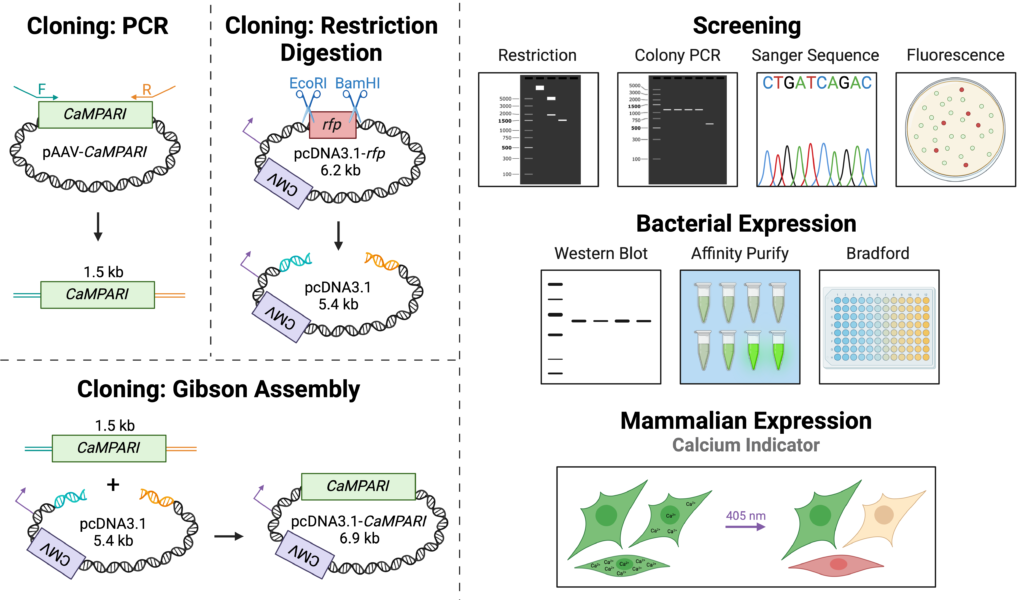
CaMPARI Cloning
Hypothesis Design
Cloning by PCR
Plasmid DNA Purification/Quantification
Ligation and Transformation
Screening Clones (Fluorescence, PCR, Sequencing)
Gibson Assembly
CaMPARI Expression in E. coli and animal cells
Hypothesis Testing
Protein Purification
SDS-PAGE & Western Blotting
Animal Cell Culture & Transfection
Fluorescence Microscopy
Quantitative Data Anaylsis
BIT 410/510 lab roadmap. Figure created with BioRender.